Royal Society Apex Awards 2027 | Study in the United Kingdom — British Academy, Royal Society, Royal Academy of Engineering
⚠️ This scholarship's deadline has passed and it's no longer accepting applications.


Up to £200,000, two years to spend it, and a strict rule that your project has to sit across at least two academic disciplines rather than comfortably inside one. The APEX Awards exist specifically to fund research that conventional single-discipline grants tend to overlook.
Run jointly by the British Academy, the Royal Society, and the Royal Academy of Engineering, with generous support from the Leverhulme Trust, the scheme is one of the largest interdisciplinary research grants in the UK.
About the Scholarship
APEX funding covers staff costs for the lead applicant and co-applicant, including research assistants, students, or teaching replacement, plus research costs capped at 25% of the total award value. Applicants can separately request up to £10,000 to lead public engagement activities connected to their project. Awards run for up to 24 months and are expected to start between 1 October and 31 December 2027.
The defining feature of APEX is its cross-disciplinary requirement. Every proposal must fall within the scope of at least two of the three participating academies, meaning a project limited entirely to engineering, or entirely to history, will not be accepted regardless of quality. Researchers weighing this alongside other major UK research funding sometimes compare it to the British Academy Mid-Career Fellowships, which fund single-discipline humanities and social science research leave rather than a cross-academy collaboration.
Scholarship Benefits
- Up to £200,000 in total funding
- Staff costs covered for the lead applicant and co-applicant, including research assistants and students
- Research costs covered up to 25% of the total award value
- Separate funding of up to £10,000 available for public engagement activities
- Up to 24 months to complete the project
- Backing and credibility from three of the UK’s leading academies simultaneously
Eligibility Criteria
- Applicants must be based at a UK university or a not-for-profit research institution for at least the duration of the project
- Must be an established, independent researcher with a strong track record in their field, whether science, engineering, humanities, or social sciences
- Must collaborate with a co-applicant from a different academic discipline or a different UK university
- All applications must include support from the applicant’s Head of Department
- Proposals must fall within the scope of at least two participating academies; single-academy proposals are not accepted
- Applicants may only submit one application per award cycle
- The scheme recognizes diversity as central to excellence in STEM and encourages participation from researchers of diverse backgrounds and experiences, an emphasis that also runs through the Royal Society Entrepreneur in Residence Program, a separate Royal Society scheme open to industry professionals of any nationality working in UK universities
Fields of Study Covered
Because eligibility depends on spanning at least two academies, funded projects typically combine fields such as:
- Engineering and social sciences
- Humanities and physical sciences
- Science, technology, and public policy
- Cross-cutting projects at the boundary of STEM and the arts or humanities
Required Documents
- Completed application through the Royal Society’s Flexi-Grant system
- Confirmation of support from the applicant’s Head of Department
- Details of the co-applicant and their differing disciplinary background
- Project proposal outlining how the work spans at least two participating academies
How to Apply (Step-by-Step)
1. Identify a co-applicant from a different discipline or UK university to collaborate with.
2. Secure written support from your Head of Department before starting the formal application.
3. Register or log in to the Royal Society’s Flexi-Grant grant management system.
4. Complete the online application, clearly demonstrating how the proposal spans at least two participating academies.
5. Request the separate £10,000 public engagement funding within the main application if relevant.
6. Submit before 15:00 BST on the deadline, since late applications are not accepted.
7. Await the multi-stage review process, which includes eligibility checks, panel assessment, and independent peer review before final decisions.
Selection Process
Applications go through eligibility checks, panel assessment, independent peer review, and a final panel recommendation before funding decisions are confirmed. Because the scheme specifically funds work that would struggle to secure support through conventional single-discipline programmes, reviewers weigh genuine interdisciplinary integration heavily, not just two researchers from different fields working in parallel on loosely connected questions.
Tips to Improve Your Chances
- Choose a co-applicant whose discipline genuinely changes how the research question gets answered, not just adds a secondary perspective
- Make the interdisciplinary integration explicit throughout the proposal, not just in the introduction
- Secure Head of Department support early, since this confirmation is a required part of the application
- If applying for public engagement funding, describe concrete activities rather than a general commitment to outreach
- Read past APEX award recipients’ project summaries to calibrate the level of genuine cross-disciplinary ambition expected
Frequently Asked Questions
Can I apply with a co-applicant from the same discipline as me?
No. The co-applicant must come from a different academic discipline or a different UK university, since the scheme is built specifically around cross-disciplinary collaboration.
How much of the award can go toward research costs versus staff costs?
Research costs are capped at 25% of the total award value, with the remainder generally covering staff costs for the lead applicant and co-applicant.
Is the £10,000 public engagement funding automatic?
No. It must be applied for separately within the main application and is intended specifically for public engagement activities connected to the APEX project.
How many applications can I submit per cycle?
Only one application per applicant is permitted per award cycle.
When do APEX Awards typically begin?
Awards are expected to commence between 1 October and 31 December 2027 for the current round, running for up to 24 months from that start date.
Are single-discipline research proposals eligible?
No. Proposals limited to the scope of only one participating academy, such as engineering alone or humanities alone, will not be accepted under this scheme.
Is there a similar option for researchers not yet at the established, independent stage APEX requires?
Early and mid-career researchers not yet eligible for APEX might look at the British Academy Mid-Career Fellowships instead, which sets a lower bar around years since doctorate rather than requiring an established independent track record.
Similar scholarships
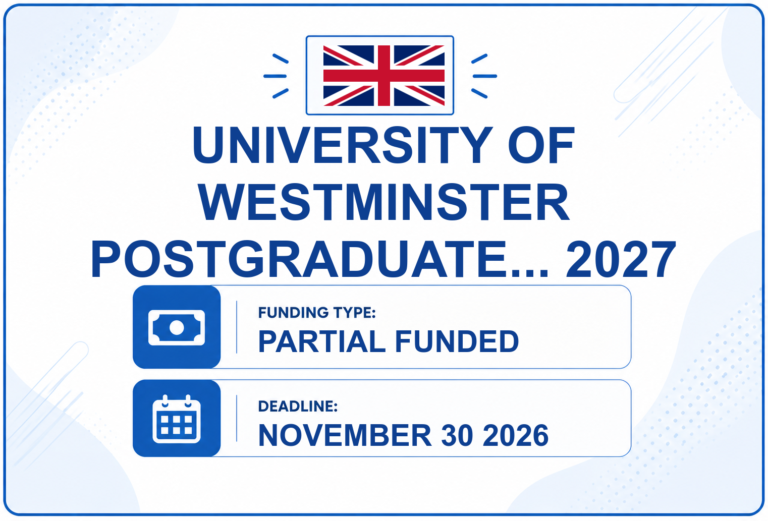
University of Westminster Postgraduate Excellence Award 2027 | Study in the United Kingdom — University of Westminster

AfOx Graduate Scholarships 2027 in the United Kingdom | Fully Funded — Mastercard Foundation, Africa Oxford Initiative, University of Oxford